
Any new commercial space is required to be accessible per the building code and federal law. But how does that work when you are renovating an existing space? That’s where the 25% accessibility rule comes in.
What is the 25% Accessibility Rule?
In Oregon, the 25% accessibility rule (ORS 447.241) applies to most alterations. It requires projects to use up to 25% of the construction budget for accessibility improvements. This upgrade requirement is in place until the building meets current accessibility standards. This is how the jurisdiction encourages building owners to update their facilities over time. For example, if an alteration includes $100 of permitted construction work, up to $25 must go toward upgrades in order from the site to the interior:
- Accessible parking
- Building entrance
- Accessible route to the altered area
- Restrooms
- Public access telephones
- Public access storage
If the space and route already meet accessibility requirements, the project may not require anything beyond confirming compliance. In minor cases, the work may only involve updates like new grab bars or door hardware.
What is the primary function?
The 25% accessibility rule applies when alterations affect the primary function of a space. This refers to the area where the main activities of a business occur.
Examples include restaurant dining areas, retail sales floors, medical exam rooms, classrooms, and offices where business operations take place.
Areas that do not qualify as primary function spaces include entrances, corridors, restrooms, break rooms, employee locker rooms, and mechanical or electrical rooms. Restrooms qualify as primary function spaces only when their primary purpose is restroom use, such as at a highway rest stop.
When alterations affect a primary function area, the path of travel to that space must also meet accessibility requirements.
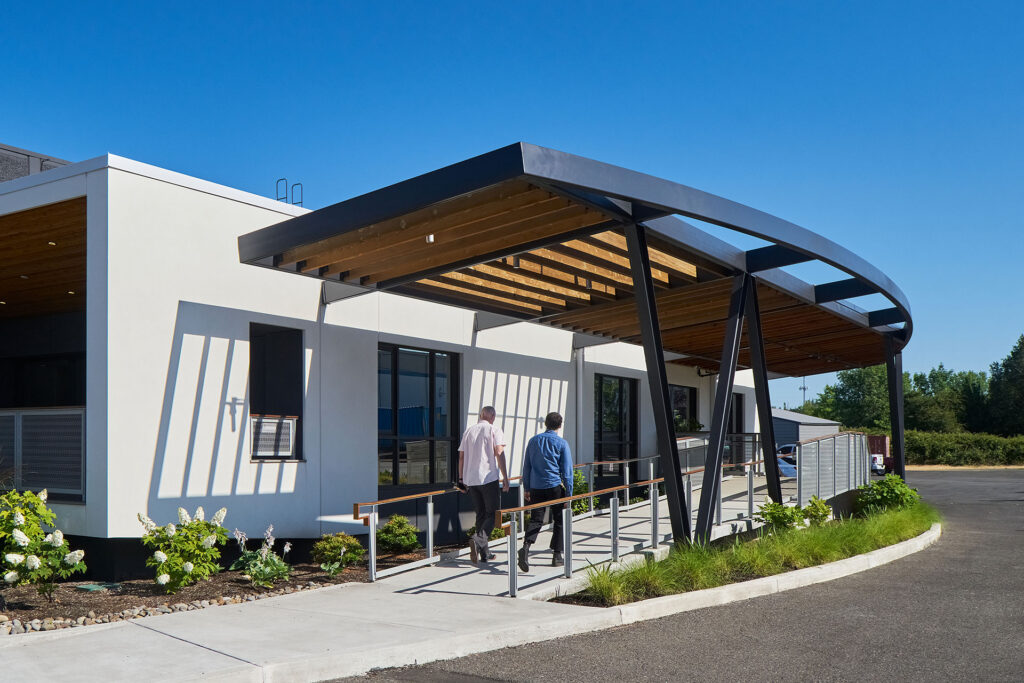
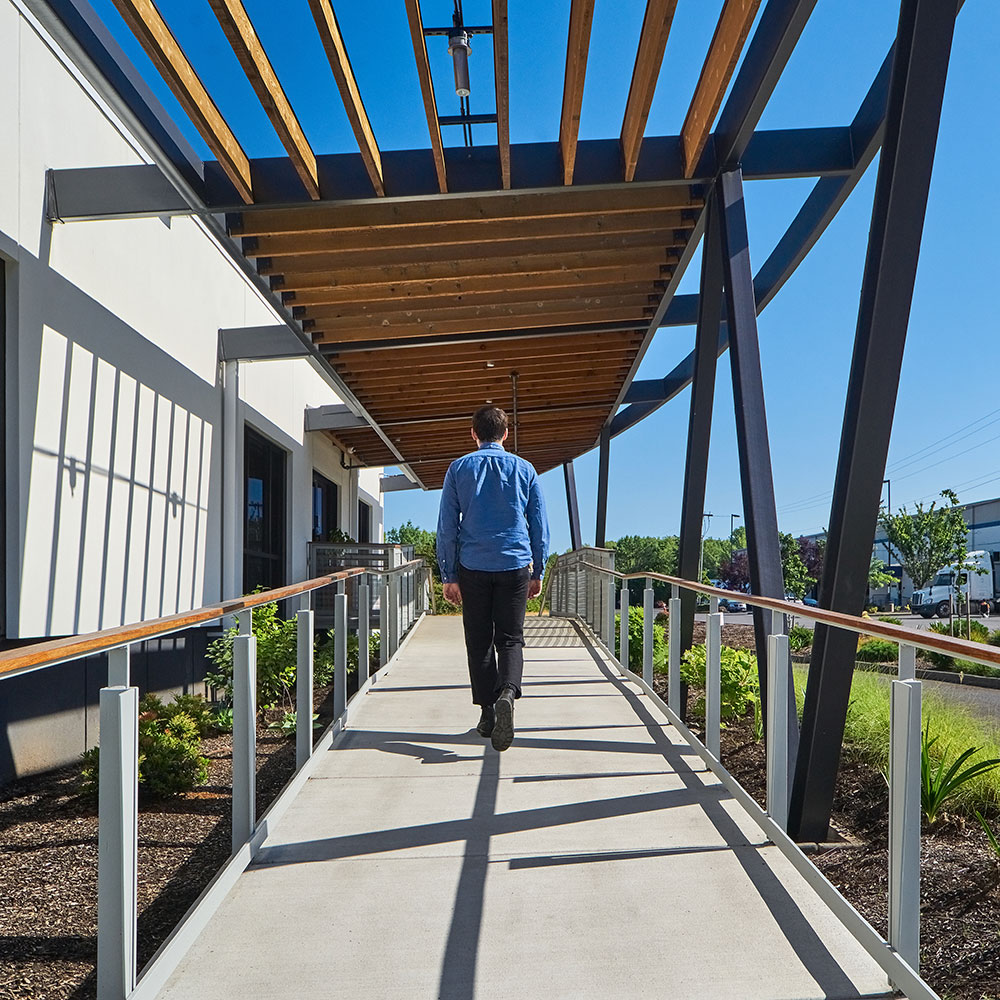
Accessible routes can take many forms depending on the building and site conditions. In one of our recent commercial projects, we redesigned the building entry to incorporate a new ADA ramp. The ramp improves the path of travel from the sidewalk to the main entrance while integrating it into the overall architectural design.
What costs count toward the construction budget?
The 25% accessibility rule is based on the value of the permitted construction work for the alteration.
Typical costs that count toward the construction budget include:
- demolition and construction work
- new walls, ceilings, and finishes
- cabinetry and built-in elements
- plumbing and electrical work related directly to accessibility (like locating an outlet in an accessible location, but not the general wiring for the project alteration)
What isn’t included (key is whether the item affects the primary function directly):
- Normal maintenance;
- reroofing;
- painting (on its own);
- wallpapering;
- asbestos, lead, or other hazardous material removal;
- automatic sprinkler retrofitting; and
- changes to electrical, mechanical and plumbing systems.
Your architect can help clarify which costs to include when calculating the accessibility portion of the project budget.
What if the existing structure can’t accommodate the required upgrades?
Tenant improvements for businesses that serve the public generally must meet accessibility requirements, though some exceptions and special considerations may apply.
Historic structures, for example, may limit how accessibility upgrades are incorporated. If a building has protected features—like original stairways, facades, or interior details—those elements often cannot be altered, which can affect how (or where) accessibility improvements are made.
In other cases, technical infeasibility may apply. This typically relates to physical constraints of the existing building, such as:
- Structural elements that cannot be removed or altered
- Limited space that prevents adding a compliant ramp or accessible route
- Floor level changes that cannot be reasonably accommodated
- Existing slab or foundation conditions that restrict relocating plumbing fixtures
Accessibility requirements may also be limited when upgrades are disproportionate to the scope of the alteration. However, simply not budgeting for accessibility improvements is not an acceptable justification.
An architect can evaluate existing conditions and determine whether the project requires accessibility upgrades or whether existing constraints make them technically infeasible.
What if my project is not in Oregon?
If a project is located outside Oregon and no local rule sets a cost threshold, federal ADA requirements typically apply. In many cases, projects must provide path-of-travel accessibility improvements up to 20% of the construction budget for the alteration.
Local jurisdictions may adopt additional accessibility requirements, so it is important to review the applicable regulations for the project location. An architect or code consultant can help determine how accessibility requirements apply to a tenant improvement project.
Do I have to install an elevator?!?
Maybe? It really depends on your business and the specific building under consideration. Some older buildings may still be skating by with savvy tenants who are able to function legally in what would now be considered non-accessible spaces. Just because you see a tenancy operating currently doesn’t necessarily mean new tenancies of the same type have that same access exception.
The jurisdictions are aware that an elevator is an expensive prospect and don’t just arbitrarily require them. So, if this is a comment coming up for a building you’d like to move into, take it seriously as a logistical issue for your tenancy. Or, be aware if your business might provoke the requirement prior to looking at new tenant spaces on upper floors. It certainly could add up to be your 25% qualification all on its own.
It’s worth noting that the ADA includes an elevator exception. In general, an elevator is not required in buildings that are less than three stories or have less than 3,000 square feet per story, except for certain uses like public transit facilities, healthcare providers, or shopping malls.
What does this mean for my project?
If you are renovating a space your business already occupies, you may already be familiar with the building’s accessibility limitations. Alterations can trigger requirements to address those conditions as part of the permitted work.
If you are considering moving into a new commercial space, it is important to evaluate how customers and staff will access the building and tenant area. Parking, entrances, routes through the building, and restrooms may all factor into the scope of accessibility improvements.
Reviewing these conditions early can help identify potential upgrades before design and permitting begin. An architect can help evaluate the space and determine how the 25% accessibility rule may apply to the project.
We can help!
If you are planning a tenant improvement or considering a new space for your business, we can help evaluate accessibility requirements and guide the project through design and permitting. Contact us to discuss your project.